blog
Why Deepak, Aarti, and Agni Are Central to Hanuman Worship
👤
DivyaDrishti Editorial
Feb 02, 2026
6 min read
0 reads
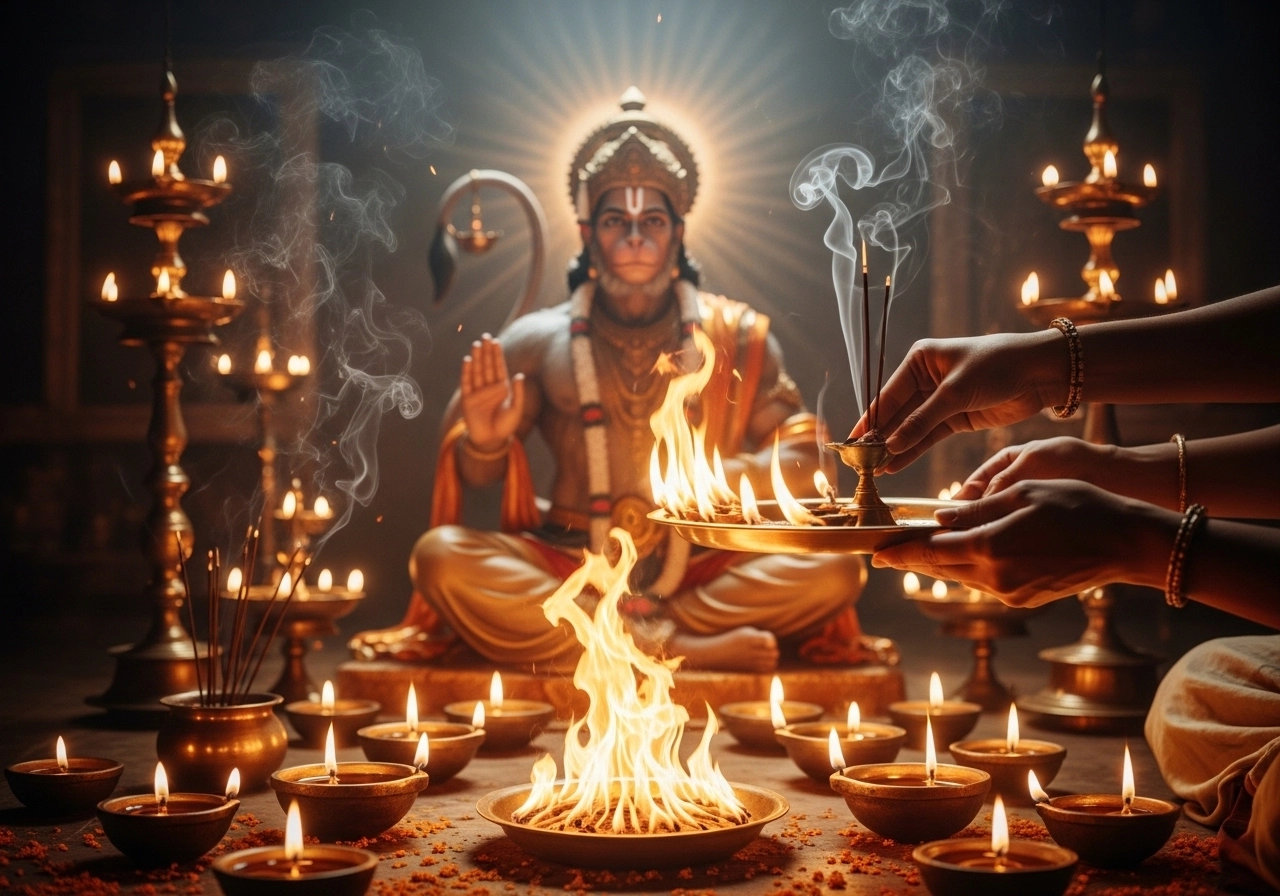
In Sanatan Dharma, fire is not a decorative element placed in rituals for visual beauty. Agni is a living technology — refined over thousands of years — designed to influence attention, emotion, memory and intention. In Hanuman worship, this role of fire becomes even more central. Diyas, deepak, burning camphor and the circular motion of aarti are not symbolic accessories. They are functional tools of alignment.
Hanuman worship is deeply action-oriented. It is not a contemplative or abstract form of devotion. It is physical, rhythmic and emotionally grounding. Agni becomes the medium through which that devotion finds a steady structure.
This is not coincidence.
It is precision.
Agni as Messenger
In Vedic understanding, Agni is the divine carrier — the one who transports offerings, intentions and awareness across realms. He stands at the threshold between the visible and the subtle. Where fire is present, boundaries soften. Communication becomes possible.
Hanuman is one of the very few deities who is described as moving freely across lokas — earth, forest, ocean, sky and the divine realms. He is the eternal messenger, the bridge between Rama and the world, between intention and execution.
Agni and Hanuman naturally mirror one another.
This is why a Hanuman temple feels distinctly alive during aarti. The moment the flame is lit and begins its slow, circular movement, the space changes. The atmosphere becomes alert but calm, energized but stable. The flame does not merely illuminate the deity. It activates the environment.
In many traditions, fire represents transformation. In Hanuman worship, fire represents transmission.
The Neuroscience of the Flame
Modern neuroscience has begun validating what ritual intelligence embedded long ago.
Studies show that:
• soft, rhythmic flame movement reduces mental noise
• peripheral visual engagement calms the amygdala, the brain’s threat-response center
• slow repetition stabilizes attention without cognitive strain
In simple language, the mind stops fighting itself.
Aarti places the flame exactly in the range where the eyes do not stare rigidly, but also do not drift. The gentle oscillation holds awareness without demanding effort. This creates a rare mental state — alert presence without pressure.
Hanuman worship requires engagement, not withdrawal. It is not about dissolving into silence. It is about becoming emotionally and mentally ready for action. Agni gives that readiness a rhythm.
The flame becomes a neurological anchor.
Why Hanuman Aarti Feels Different
Unlike elaborate temple rituals filled with layered symbolism, complex gestures and prolonged sequences, Hanuman aarti is direct.
There is:
• no excess abstraction
• no complex theological narrative unfolding
• no dependence on intellectual interpretation
The devotee arrives. The flame is offered. The bell rings. The mind settles. The body aligns.
This simplicity mirrors Hanuman’s own nature — direct, efficient and uncompromising.
Agni and Sankalp
Fire does something very specific in ritual practice — it externalizes intention.
When a devotee lights a diya before Hanuman, intention stops being internal thought and becomes visible action.
Offering a flame is not a request for blessings. It is a declaration of posture.
Readiness to serve.
Readiness to act.
Readiness to protect dharma in daily life.
The diya becomes a personal commitment, not a transactional offering.
Closing Insight
Fire does not ask for belief.
It asks for presence.
Hanuman responds to readiness.
This is why deepak, aarti and agni remain central to Hanuman worship.